A Short History of the Jews of Cuba

also in this page: A Short History of TheCAJM

Religious persecution in the fifteenth century brought Jewish life to an end in Spain. The Spanish Inquisition gave Jews the choice to either convert to Catholicism or be expelled. Most Jews left for points east in the Mediterranean or north to France or the Netherlands. Those who stayed converted, but many continued to practice Judaism secretly. These “pretenders” of Catholicism were called los Marranos, which referred to the pork they would eat in public for show their support of Catholicism. Many Marranos headed for the “New World” where they established their communities, complete with synagogues. In Spanish controlled territories, however, while less threatened by the local government, the practice remained secret. In Cuba where the Inquisition was strong it was very difficult to continue Jewish practices even in secret. These “New Christians” left for other locations in the New World or were absorbed into the general Spanish population of Cuba.

Cuba saw many waves of Jewish immigration after the Spanish-American War. During the 1920s, with the tightening of immigration quotas into the U.S.A., Jews, mainly from Turkey and Eastern Europe, settled all over the island. Young men from Eastern Europe, both single and married, came to make a better life or to wait until they could get permission to immigrate to the U.S. Many quickly became successful peddlers and small businessmen. The married ones sent to Europe for their families and bought homes. Single men either sent to the “old world” for wives or intermarried with the Cuban Catholic population. Those from Turkey and other Sephardic Jews tended to arrive as family units. Since life in Havana was more expensive than in the countryside and more opportunities for economic success existed in other cities, the Sephardic influence became widespread across the island.

In the 1930s, Cuban Jews participated in an active communal life and they published a number of newspapers in Yiddish and Spanish with diverse religious and political orientations. Cuba was the first country in the Americas to allow Jews fleeing persecution in Europe to enter, when other countries – notably the United States – refused. Cuba was the first country in the Americas to allow Jews fleeing persecution in Europe to enter, when other countries refused. During this time, a central Jewish committee was created to represent all Jewish groups. As the 1930s progressed, there were episodes of anti-Semitism, a new phenomenon in Cuba. The plight of the Havana-bound passengers stranded on the German liner St. Louis dramatized the tragedy of Jewish refugees fleeing Nazi Germany, yet they were also denied admission to Cuba. The plight of the Havana-bound passengers stranded on the German liner St. Louis dramatized the tragedy of Jewish refugees fleeing Nazi Germany, yet they were also denied admission to Cuba.

But the problem of anti-Semitism, literally disappeared during W.W.II. After the war, there was a large influx of immigrants from Europe and by the 1950s, when Batista (the last American-supported dictator) ruled; a vibrant community of fifteen thousand Jews existed. Ashkenazim accounted for some three-quarters of the community with 75% lived in Havana and the rest in the rural provinces. However, after the Castro led revolution in 1959 and until 1961, over 90% of these Jews fled the country and, along with many of their non-Jewish countrymen, moved to the United States, mainly Miami, Florida, parts of New Jersey and New York. Others went to various Latin American countries or Europe. Some Jews moved to Israel. The Reform movement, an American led group, was present during most of the 20th century. It came to an end when the last Reform rabbi left for the United States after the Castro revolution. By 1989, Cuba's practicing Jewish population was depleted to a low of 800 people or less.

Although the Castro led revolution was not directed against Jews, it destroyed the economic stability of Cuban Jewry, which was primarily middle class private business oriented. The reason for the flight was not anti-Semitism, but the economic shift from capitalism to communism. The majority of those who remained were either firm believers in the communist system that frowned on religious practice, were intermarried with strong non-Jewish family attachments, or were too poor to leave. Either way, they were concerned for their economic welfare if they would be labeled “Believers.” Thus most Jews let go of their religious practices and those born after 1955 were too young to have ever experienced any form of Judaism.

After the Soviet Union disintegrated and withdrew their economic partnership with Cuba in 1989, the economy took a severe turn downward and common everyday items necessary for basic survival were in short supply. In desperation for spiritual support, people began turning to the various religious institutions for comfort and hope. The government, recognizing the needs of the people, changed the law that forbade “Believers” in any religious persuasion to be members of the party. This change allowed people to practice religion while keeping top echelon jobs. The previous law also kept children of “Believers from attending the best schools and made it difficult for these people to gain admission to the University, thereby limiting job opportunities and economic advancement. The old law did, however, protect against national, religious or racial hate and that has not changed. The new law gave Jews, along with all Cubans, freedom to worship, and the opportunity to receive ritual items and kosher holiday food from abroad. In addition, the distribution of kosher beef that had been in effect since the Revolution for registered members of the various synagogue communities continued as the government recognized that these people needed beef rather than the pork available in the ration stores.

Communist Cuba maintained normal relations with Israel until the 1967 War when its foreign policy became firmly anti-Zionist. It joined the Third World, in 1973, in severing diplomatic ties but Aliyah which began at the time of the creation of the state of Israel and continued after the Communist Revolution did not end when the political relationship changed. In fact, there has been an increase in Aliyah since the renewal of religious life after 1991. 

Before the law changed, a few Jewish families continued to observe Shabbat and major holidays in their own homes, even though candles, bread and other supplies were hard to obtain. 1980s when the daily minyan usually consisted of seven elderly men and three Torah scrolls, placed on chairs in the small chapel. Today, the Jewish community is thriving. There are three synagogues in Havana with regular minyanim each Shabbat and on holidays at Conservative Ashkenazic and Sefardic synagogues and daily minyanim at the Orthodox shul. Synagoga Beth Shalom, at the Patronato in the Vedado Section, was built in the 1950s. Now, it is the cultural and religious center of Havana’s Jewish life The Sephardic community continues to practice its rituals at Centro Sefardi, a building that was constructed in Vedado area in the 1950 when its community had mostly moved from Habana Vieja where its first synagogue, Shevet Achim, remained with a small minyan until that old building was deemed structurally unsound. Today, there are efforts afoot to turn that building into a museum, but this still only a dream.

Several years ago, the Patronato affiliated itself with the Conservative Movement. Since then, all communities except the Orthodox, Congregation Adath Israel, have also affiliated with the Conservative Movement. Dr. Miller, president of the only national Jewish institution, known as the Joint Coordinating Committee (in Spanish: Comision Coordinadora), invited the American Joint Distribution Committee to help with the development of religious life on the island. Now there is a resident representative of the JDC assisting with the development of educational and social programming. There are many educational programs including a Sunday school for both children and adults and a training program for b’nai mitzvah. Social programs include groups for youth, middle-aged individuals, and seniors.

Adath Israel, located in Old Havana, is the city’s Orthodox Shul. It also has the only mikva on the island. This synagogue receives regular support from Chabad Organization in Toronto, Panama, and Peru and Florida. Rabbis and educators are sent for each holiday and a few weeks in the summer. Kosher food is sometimes sent from Peru and chickens are also sent by a man in Paris. However, the kitchen at the synagogue is only kosher style. Meals are served twice a day to those who come for services. The majority of the membership of this congregation is made of retired people in their seventies and eighties. In late 1994, the first Orthodox Bar Mitzvah, in thirty years, was held here and the young man still participates by leading services, and is currently the treasurer of the congregation. Other bar mitzvah's occur occasionally.

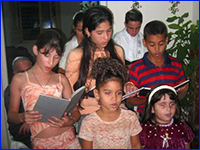
There are several active small communities across the island. Each one has a character of its own and each is happy to receive visitors. They are located in Cienfuegos, Caibarien, Santa Clara, Sancti Spritus, Manzanillo, Campechuela, Santiago de Cuba, and Guantanamo. The synagogue building in Santiago de Cuba was rededicated in 1995 and the one in Camaguey reopened in 1997. The synagogue in Camaguey continues to thrive with a religious school, youth group, and holiday services. In Santiago de Cuba, at the far end of the island, the synagogue building was returned after twenty-five year during which it was used for various venues such as a youth center and a dance school. Since its rededication, the community has held weekly Kabbalat Shabbat and Shabbat services with study sessions each week. All holidays are celebrated and several members are trained to lead services. There have been 4 B’nai Mitzvah since 1996, some weddings, and two births. There is an active youth group and dance group. Study is intergenerational as are social activities. Other smaller communities meet in private homes.

The future of the Cuban Jewish Community, as well as the whole of the Cuban people, depends on the island’s political and economic situation. Cuba has had the highest literacy rates, lowest infant mortality rates and the highest number of doctors per capita in all of Latin America. Jews have traditionally gravitated to the various professions and through hard work have moved into high-ranking positions in both the traditional professions and now in the Cuban business world.


We, as Jews, are committed to assisting our brothers and sisters in Cuba in their efforts to maintain a healthy life style and to reestablish ties to their heritage.

To know more about the history of the Jews of Cuba:


The Jewish Community in Cuba in the 1990s, by Arturo Lopez Levy

The Virtual Jewish History Tour- Cuba, by Rebecca Weiner


A Short History of The Cuba-America Jewish Mission

For the first 4 years of our work, members of various San Francisco East Bay congregations lovingly donated time, money, and supplies to assist in the rebirth and development of the Jewish communities in Cuba. Two rabbis had graciously offered the use of their discretionary funds to receive and monitor donations. Other congregations and local chapters of organizations like B'nai B'rith, NCJW, and Hadassah donated space in their newsletters to keep everyone informed of our plans, and needs and the progress of our work. In fact, B'nai B'rith continues to do so to this day and we work closely with them on their own project to support the work of the Maimonides Lodge in Havana.

In 1995, Ljuba Davis of Berkeley and her sister, Gloria Mintz of Las Vegas flew to Santiago de Cuba to prepare that community for it's first High Holy Days since 1962. Later, with the establishment of a sister-congregation relationship between Congregation Netivot Shalom in Berkeley and Comunidad Hebrea Hatikva in Santiago de Cuba in 1996, Rabbi Stuart Kelman and a group of synagogue member and friends traveled on a very successful trip of friendship and study. The trip was so satisfactory that it led to the development of ongoing supportive relationships. In addition, we experienced the enthusiasm of the Hatikva membership as they developed greater understanding of our common heritage. We quickly accepted the invitation to return the following December for the first B'nai Mitzvah celebrations in Santiago in over twenty years. The relationship between the two groups has continued ever since with contact through letters, phone calls, a visit in 1997, and email. Donations of humanitarian, ritual, and educational aid have been packaged (and more bought with monetary donations) and sent by way of travelers whom the CAJM has prepared for their trips with information using videos, photos, and providing contact names.

What began as a helping hand to Comunidad Hebrea Hatikva in Santiago de Cuba grew to encompass needs throughout the island. Today, we work very closely with Dra. Rosa Behar at the Jewish Pharmacy in Havana and we do our best to support the goals of the leadership in Havana under the presidency of Dr. Jose Miller. As the work continued to grow, it became a full time job requiring a formal structure to develop better resources for funding and for the dissemination of information Thus, with the help of friends and the blessings of the rabbis and others involved, we established The Cuba-America Jewish Mission, a nonprofit organization to assist the Jews of Cuba with their efforts to maintain good health and to return to the Jewish fold.

There are several organizations involved in assisting the Jewish community of Cuba and the number continues to grow. The J.D.C. with its main office in NYC is the primary organization of assistance. The websites of others involved can be found by going to www.jewishcuba.org. All have their unique ways of assisting and all are necessary in such a monumental endeavor.


TheCAJM  News  Projects  How to Help  Travels to Cuba  Contact Us